Mostly Misaligned Mirrors (#215)
Recently, my stochastic professor introduced me to a problem he has been pondering for over two decades: on the two-dimensional integer lattice scale(1.000401)%27%3E%3Cuse%20x=%270%27%20y=%27-4.18568%27%20xlink:href=%27%23g0-1%27/%3E%3C/g%3E%3Cg%20transform=%27translate(0%2013.948)scale(.999987)%27%3E%3Cuse%20x=%277.9699%27%20y=%27-8.522894%27%20xlink:href=%27%23g1-1%27/%3E%3C/g%3E%3C/g%3E%3C/svg%3E)
scale(1.000401)%27%3E%3Cuse%20x=%270%27%20y=%27-4.18568%27%20xlink:href=%27%23g0-1%27/%3E%3C/g%3E%3Cg%20transform=%27translate(0%2013.948)scale(.999987)%27%3E%3Cuse%20x=%277.9699%27%20y=%27-8.522894%27%20xlink:href=%27%23g1-1%27/%3E%3C/g%3E%3C/g%3E%3C/svg%3E)
 one shall flip a three-sided coin for each point and uniformly place one of three mirrors,
one shall flip a three-sided coin for each point and uniformly place one of three mirrors, scale(1.000401)%27%3E%3Cuse%20x=%270%27%20y=%27-4.18568%27%20xlink:href=%27%23g0-2%27/%3E%3Cuse%20x=%275.9804%27%20y=%27-4.18568%27%20xlink:href=%27%23g1-1%27/%3E%3Cuse%20x=%2716.610666%27%20y=%27-4.18568%27%20xlink:href=%27%23g2-1%27/%3E%3Cuse%20x=%2723.850572%27%20y=%27-4.18568%27%20xlink:href=%27%23g0-1%27/%3E%3Cuse%20x=%2729.165705%27%20y=%27-4.18568%27%20xlink:href=%27%23g2-1%27/%3E%3Cuse%20x=%2734.412811%27%20y=%27-4.18568%27%20xlink:href=%27%23g1-2%27/%3E%3Cuse%20x=%2745.043076%27%20y=%27-4.18568%27%20xlink:href=%27%23g0-3%27/%3E%3C/g%3E%3C/g%3E%3C/svg%3E)
scale(1.000401)%27%3E%3Cuse%20x=%270%27%20y=%27-4.18568%27%20xlink:href=%27%23g0-2%27/%3E%3Cuse%20x=%275.9804%27%20y=%27-4.18568%27%20xlink:href=%27%23g1-1%27/%3E%3Cuse%20x=%2716.610666%27%20y=%27-4.18568%27%20xlink:href=%27%23g2-1%27/%3E%3Cuse%20x=%2723.850572%27%20y=%27-4.18568%27%20xlink:href=%27%23g0-1%27/%3E%3Cuse%20x=%2729.165705%27%20y=%27-4.18568%27%20xlink:href=%27%23g2-1%27/%3E%3Cuse%20x=%2734.412811%27%20y=%27-4.18568%27%20xlink:href=%27%23g1-2%27/%3E%3Cuse%20x=%2745.043076%27%20y=%27-4.18568%27%20xlink:href=%27%23g0-3%27/%3E%3C/g%3E%3C/g%3E%3C/svg%3E)
 , where
, where scale(1.000401)%27%3E%3Cuse%20x=%271.9928%27%20y=%27-4.18568%27%20xlink:href=%27%23g0-1%27/%3E%3C/g%3E%3C/g%3E%3C/svg%3E)
scale(1.000401)%27%3E%3Cuse%20x=%271.9928%27%20y=%27-4.18568%27%20xlink:href=%27%23g0-1%27/%3E%3C/g%3E%3C/g%3E%3C/svg%3E)
 denotes not placing a mirror. After having populated the world, one picks their favorite integer tuple and points a beam of light in one of the four cardinal directions. With what probability does the light fall into a loop, never fully escaping?
denotes not placing a mirror. After having populated the world, one picks their favorite integer tuple and points a beam of light in one of the four cardinal directions. With what probability does the light fall into a loop, never fully escaping?
-=-
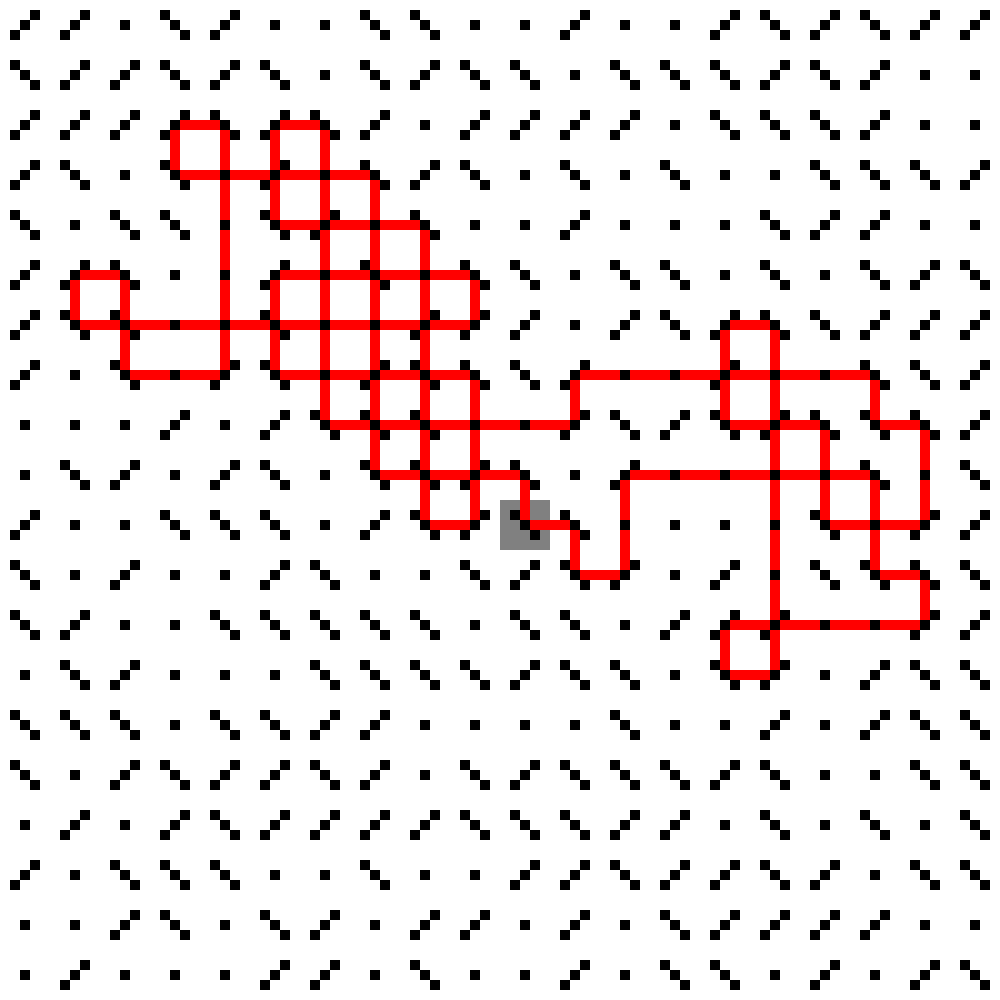
With me almost surely not being able to solve this problem thru proof, I took the route of silicon-assisted problem analysis: simulation. However, even on very large lattice segments, the beam often either escapes or exists only for a very short time — as seen above.
Source code: mostly-misaligned-mirrors_visualize.py, mostly-misaligned-mirrors_simulate.py
An example of a rather intricate path which eventually escapes the chosen view:
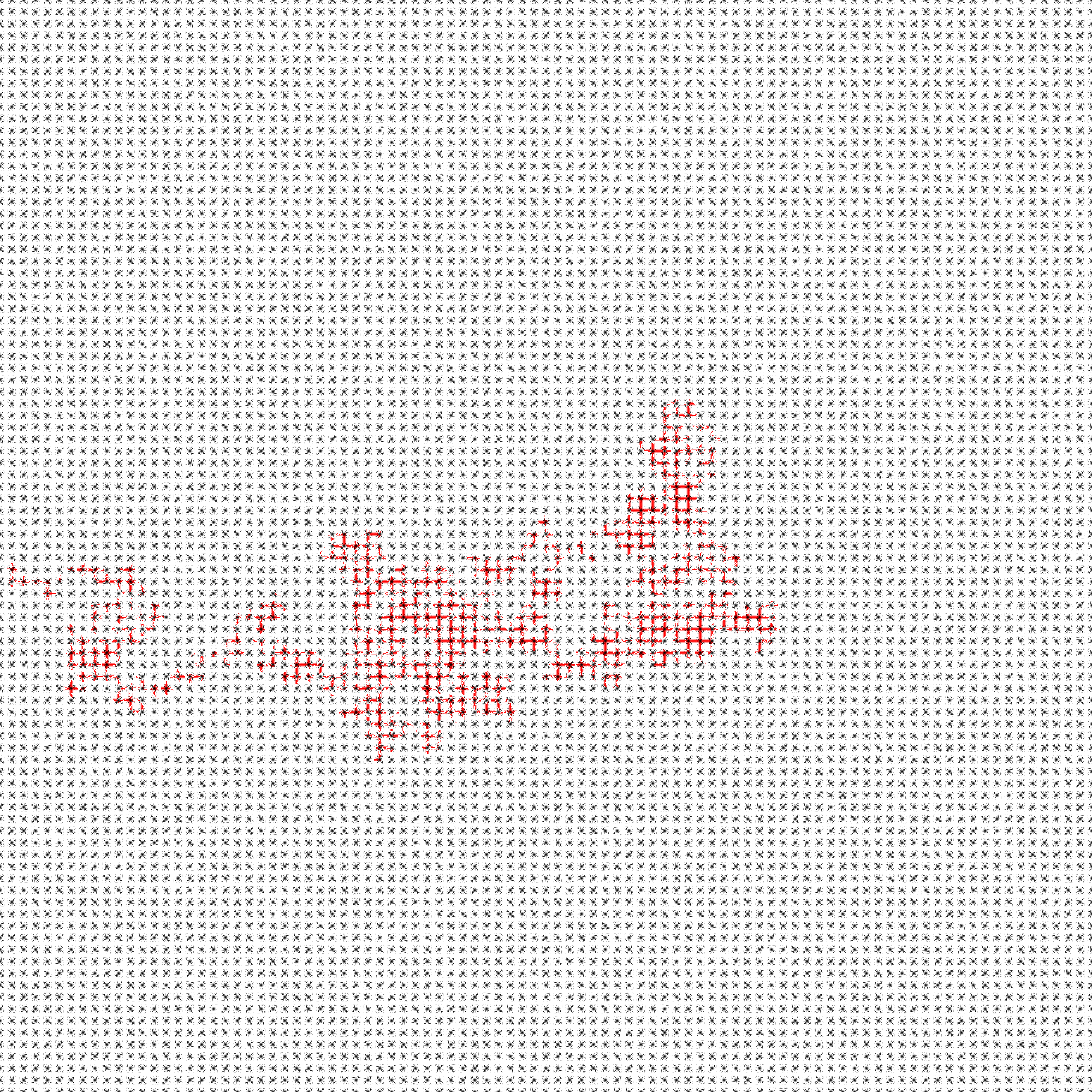
After seeing the beams often escape my view frames, I decided to also simulate the problem without visualization — both to potentially get a performance increase as well as to lift the constraints of finite imagery. My results for running ten simulations are as follows:
$ python mostly-misaligned-mirrors_simulate.py 10
[X] Exceeded the maximum visited mirrors threshold of 1000000.
[X] Exceeded the maximum visited mirrors threshold of 1000000.
[.] Visited 5110 mirrors before falling into a loop.
[X] Exceeded the maximum visited mirrors threshold of 1000000.
[.] Visited 4 mirrors before falling into a loop.
[X] Exceeded the maximum visited mirrors threshold of 1000000.
[X] Exceeded the maximum visited mirrors threshold of 1000000.
[X] Exceeded the maximum visited mirrors threshold of 1000000.
[X] Exceeded the maximum visited mirrors threshold of 1000000.
[X] Exceeded the maximum visited mirrors threshold of 1000000.
One can clearly see that whilst some paths are of minuscule lengths, others far exceed those, traversing over a million mirrors until getting stopped as to not fry my machine.
My professor’s conjecture states that any given mirror configuration almost surely — meaning with probability 1 — causes the beam of light to fall into a cycle. In some sense it appears intuitively clear — escaping requires an infinite amount of mirrors to be placed correctly, however: could the beam also find a sneaky way around a lot (in the sense of being of non-vanishing measure) of configurations, squeezing elegantly and indefinitely around all obstacles? After running my simulations doubts in the former increase, leaving me cluelessly in the dark, waiting for a proper proof to be formalized.